
Scorpions in the San Antonio Area: How to Identify Them and What to Do
Scorpions in the San Antonio area come in two kinds, and only one of them is likely to turn up in your house. The chart sorts them by where they live, and each one below has a drawing, the details that give it away, and what to do.
Updated November 4, 20267 min read
Quick answer
Texas Parks & Wildlife counts two scorpion species in Central Texas, and both have been recorded around San Antonio. The striped bark scorpion, yellowish-tan with two dark stripes down its back and about 2½ inches long, is the one found in and around homes. The Texas cave scorpion is dark-colored, lives in caves and on rocky limestone hillsides, and is unlikely to come inside. Texas A&M AgriLife says stings from Texas scorpions cause moderate reactions in most people.
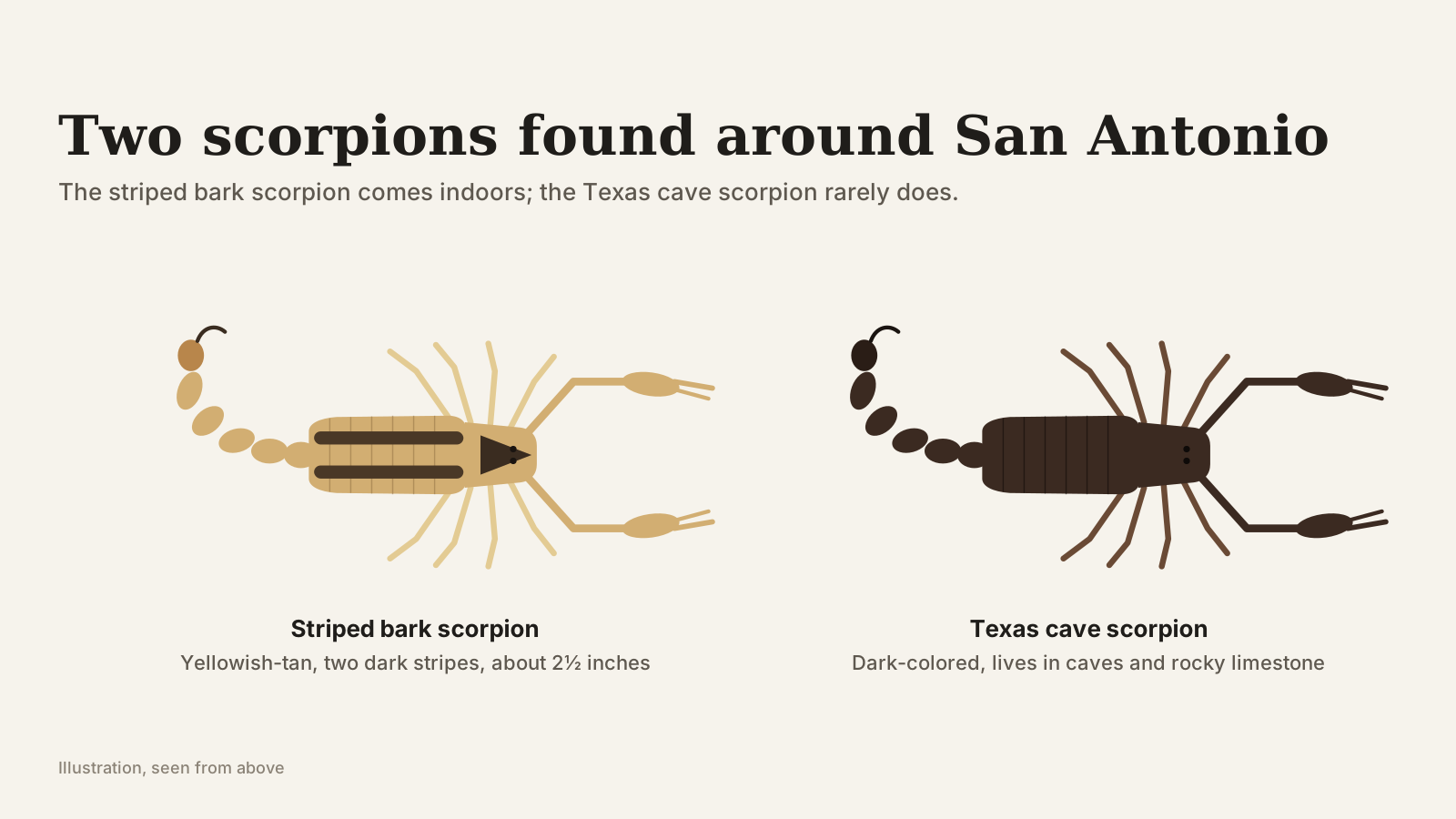
San Antonio scorpions, from rarely seen to common in homes
Caves and rocky hillsides
- Texas cave scorpion
Yards, walls, attics and living areas
- Striped bark scorpion
Drawn from where Texas A&M AgriLife and Texas Parks & Wildlife say each one lives. Both have a stinger.
What are you seeing?
- A tan scorpion with two dark stripes, on a wall, in the attic or inside the house
- A striped bark scorpion, the most common scorpion in Texas and the one that comes indoors.
- A scorpion carrying a mass of babies on its back
- A female with her young. Newborn scorpions climb onto their mother's back and ride there for up to about two weeks before going off on their own.
- A dark scorpion under a rock or in oak leaves on a limestone hillside, or in a cave
- Possibly a Texas cave scorpion, the area's other species. It is unlikely to turn up in or around a house.
- Something that glows under a black light at night
- A scorpion. Scorpions are the only arachnids known to glow under black light.
Dealing with this right now?
Finding striped bark scorpions in the house? Bob Jenkins Pest & Lawn Services treats scorpions across the San Antonio area and will look at where they're getting in.
The two scorpions, one by one
Striped bark scorpion
Comes indoors
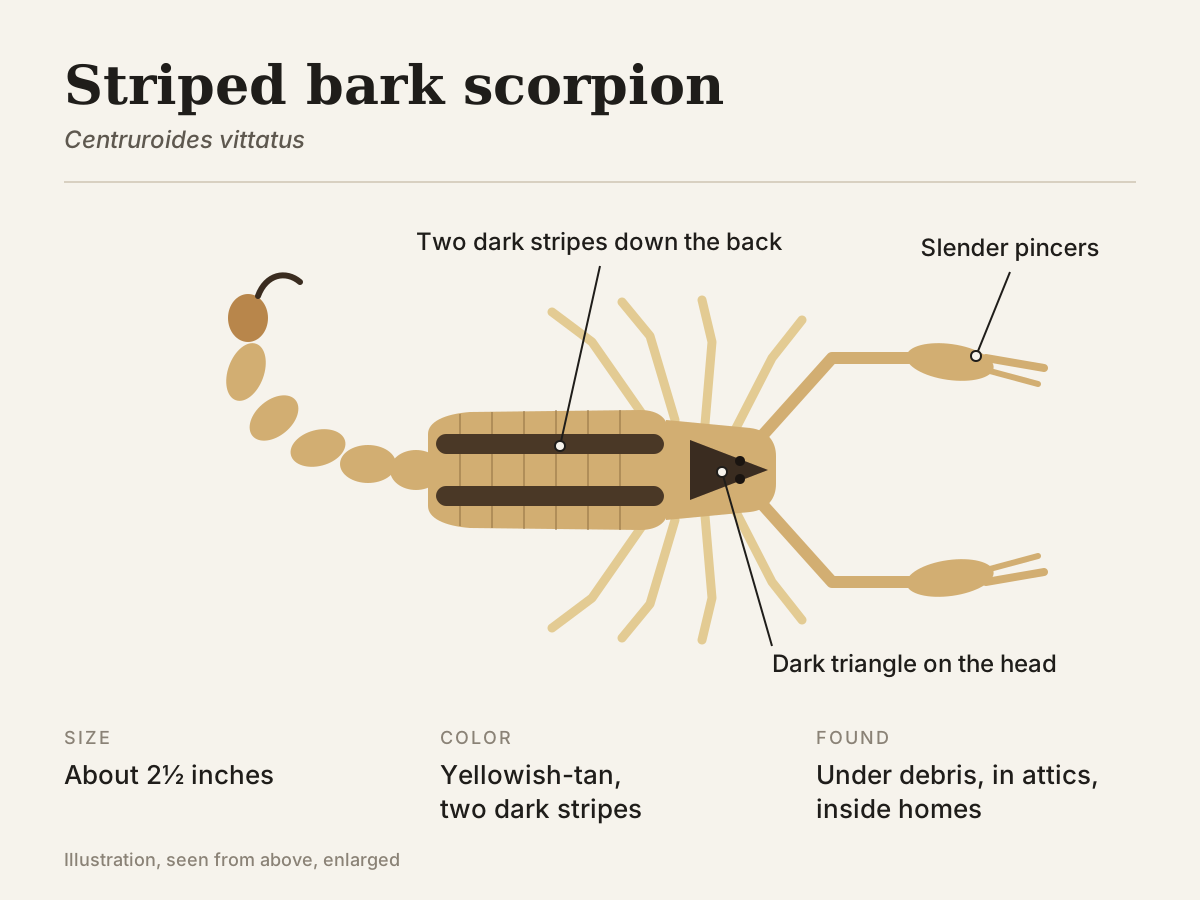
Texas A&M AgriLife calls the striped bark scorpion (Centruroides vittatus) the most common scorpion in Texas, and the only one of the state's 18 species found throughout it. Adults are about 2½ inches long and yellowish-tan, with two broad, dark stripes running the length of the back and a dark triangle on the front of the head above the eyes. The quickest tells are its slender pincer arms and its long, slender tail, which is longer on males than on females. Young ones can be lighter, with the base of the pincer arms and the last segment of the tail dark brown or black.
It hunts on the move and doesn't burrow. AgriLife finds it under rocks and boards, in debris, around dead plants and fallen logs, and in and around houses. It climbs trees and walls, it is often found in attics, and in hot weather it can move down into the living areas to get away from the attic heat. In hot, dry summers, Bexar County's AgriLife entomologist has reported a run of calls from San Antonio residents, as scorpions go looking for water or a more comfortable spot. A female gives birth to 13 to 47 live young, and the species lives about four years.
What to do: Clear rocks, boards, logs and other debris away from the house, trim branches that touch the roof, and seal the gaps they use: weather-stripping on loose doors and windows, copper mesh or screen wire in brick weep holes, and sealant around eaves and pipes. Texas A&M AgriLife notes scorpions are hard to control with insecticides alone, which is why scorpion control starts with the yard and the entry points.
Scorpions in the house?
Bob Jenkins Pest & Lawn Services treats scorpions across the San Antonio area. Tell us what you're seeing, and a technician will look at where they're getting in and treat the places they hide.
Texas cave scorpion
Rarely near homes
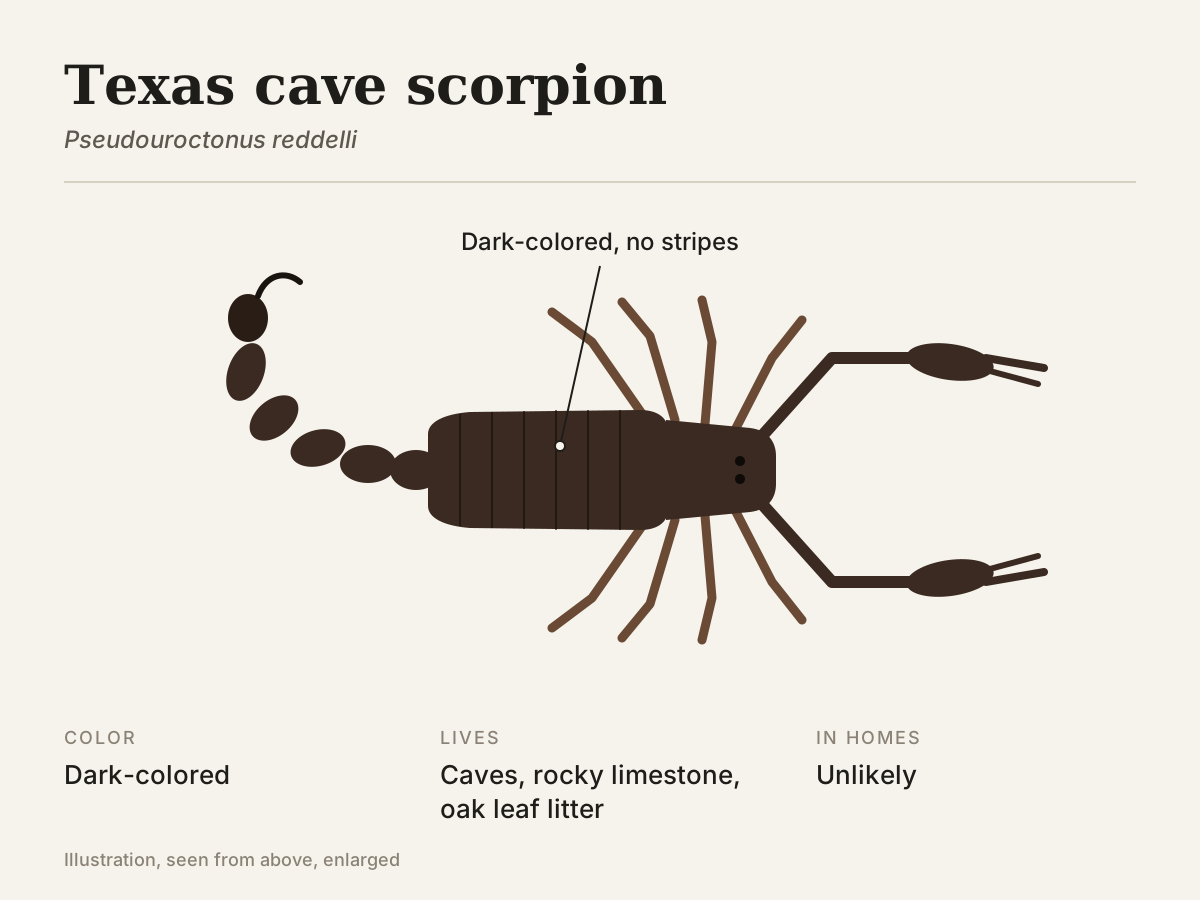
Texas Parks & Wildlife counts two scorpion species in Central Texas, and this is the other one. The Texas cave scorpion (Pseudouroctonus reddelli) is dark-colored, which is the quickest way to tell it from the tan, striped bark scorpion. It lives in caves, grottos and other limestone karst along the Balcones Escarpment and feeds mostly on cave crickets. Researchers who studied its range in 2014 collected it in northwest San Antonio and north of New Braunfels.
Despite the name, it has none of the adaptations of true cave animals, and the same study found it can be common on the surface in rocky areas with oak leaf litter. Texas Parks & Wildlife describes it as reclusive, striking only if bothered, and says it is unlikely to turn up in or around a home.
What to do: Usually nothing: one under a rock on a hillside is where it belongs. A scorpion inside the house is far more likely to be a striped bark scorpion; see scorpion control in San Antonio.
How to tell the two apart
Color and place settle most cases. A tan scorpion with two dark stripes, found in or around a house, is a striped bark scorpion. A dark scorpion under a rock in oak leaves on a limestone hillside, or in a cave, may be a Texas cave scorpion.
| Striped bark scorpion | Texas cave scorpion | |
|---|---|---|
| Color | Yellowish-tan with two broad dark stripes down the back | Dark-colored |
| Where it lives | Under rocks, boards and debris; climbs trees and walls; often in attics | Caves and limestone karst; rocky hillsides with oak leaf litter |
| In homes | Often | Unlikely, says Texas Parks & Wildlife |
Finding them with a black light
Scorpions hide during the day and come out at night to hunt, so that is when to look. Texas Parks & Wildlife notes that scorpions are the only arachnids known to glow under black light, thanks to fluorescent chemicals in their exoskeletons, so one that is hard to see under a regular flashlight stands out under a UV light.
Keeping scorpions out of the house
Texas A&M AgriLife says scorpions are hard to control with insecticides alone, so the first step is changing what's around the house. Bexar County's AgriLife entomologist and her Travis County colleague both call exclusion the best defense. For a longer walk-through, see how to get rid of scorpions in San Antonio. AgriLife's list:
- Remove trash, logs, boards, stones, bricks and other debris from around the house.
- Keep grass mowed short near the house, and prune bushes and branches back from it; branches that touch the roof give scorpions a path onto it.
- Keep firewood outside until it goes straight onto the fire.
- Store garbage cans in a frame that holds them off the ground.
- Put weather-stripping around loose-fitting doors and windows.
- Plug weep holes in stone or brick veneer with copper mesh, a nylon scouring pad or small squares of screen wire. Steel wool rusts when wet, so use it only on dark-colored walls.
- Seal around roof eaves, pipes and other cracks, and keep window screens in good repair and tight in their frames.
If someone is stung
Texas Parks & Wildlife says there are no medically dangerous scorpion species in Texas. Texas A&M AgriLife says stings from Texas scorpions cause only moderate reactions in most people, because the venom has little effect on the nervous system, though how bad a sting is depends on the scorpion and on the person.
AgriLife's advice: an ice pack on the sting relieves some of the pain and swelling, and the person should be watched closely for several hours in case of an allergic reaction. Get medical attention right away if breathing becomes difficult, hives appear, or the pain or swelling doesn't let up. AgriLife also warns that young children and adults who are allergic to the venom can have serious reactions, even fatal ones.
When to call for help
If you keep finding scorpions inside or in the attic, the gaps they are using are worth finding. AgriLife's own publication points homeowners to a pest control operator as one option. Bob Jenkins Pest & Lawn Services treats scorpions in homes across the area, from Helotes and Boerne to New Braunfels. See scorpion control in San Antonio, or contact us and we'll identify what you're finding.
Recommended services
Sources
- Texas A&M AgriLife Extension: Scorpions (ENTO-PU-032, Wizzie Brown, 2022)
- Texas A&M AgriLife Today: Hot, dry summer has scorpions in Texas heading indoors (2018)
- Texas Parks & Wildlife magazine: Texas Scorpions, Fearsome, Fascinating, Fluorescent (2014)
- Bryson et al., BMC Evolutionary Biology: Phylogeography of the Texas cave scorpion, Pseudouroctonus reddelli (2014)
Frequently asked questions
Texas Parks & Wildlife counts two scorpion species in Central Texas, and both have been recorded around San Antonio: the striped bark scorpion and the Texas cave scorpion. The striped bark scorpion is the most common scorpion in Texas and the one found in homes. The Texas cave scorpion lives in caves and on rocky limestone hillsides and is unlikely to come inside.
Texas Parks & Wildlife says no scorpion species in Texas is medically dangerous, and Texas A&M AgriLife says stings from Texas scorpions cause moderate reactions in most people. AgriLife advises watching a person who was stung for several hours and getting medical attention right away for trouble breathing, hives, or pain or swelling that persists.
Scorpions don't like very hot or very cold temperatures. In hot, dry weather they look for water or a more comfortable spot, and Texas A&M AgriLife notes that striped bark scorpions are often found in attics and may move down into the living areas to escape the attic heat.
Adult striped bark scorpions, the ones found in homes, are about 2½ inches long, according to Texas A&M AgriLife. The male's tail is longer than the female's.
Yes. Texas Parks & Wildlife notes that scorpions are the only arachnids known to glow under black light, because of fluorescent chemicals in their exoskeletons. They hide by day and hunt at night, so after dark is when to look.
Related articles
Keep reading
Scorpion Control in San Antonio: How to Get Rid of Scorpions for Good
The striped bark scorpion is the species most commonly found in San Antonio homes, and it thrives in the rocky terrain near the Hill Country. Here is what actually works to keep them out.
Read more AntsAnt Invasions in San Antonio: Species to Know and How to Stop Them
San Antonio's diversity of ant species (from the familiar imported fire ant to the more recently established tawny crazy ant) means that a treatment that works perfectly for one species may do nothing for another. Species identification is the essential first step.
Read more AntsFire Ant Control in Bexar County, TX: Protect Your San Antonio Yard and Family
Red imported fire ants are established throughout Bexar County and show no signs of retreating. Here is how to reduce colonies and protect your family and pets.
Read moreReady to be pest-free?
Request your free quote online, or call us with any questions. Your safety is our first concern.
Where are you located?
Step 1 of 2Your ZIP
Your details
So we can confirm we serve your area.
Free & no obligation · Takes 60 seconds · No spam
Prefer to call? (726) 265-1729